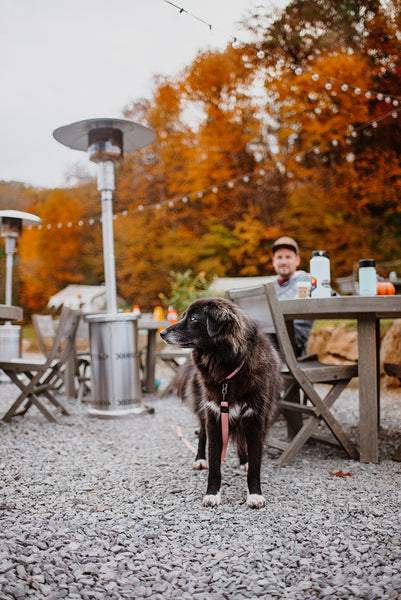
The sun was out. The patio at Ex Novo Brewing on North Flint was packed. Dogs were everywhere — goldens, pitties, a very confused-looking dachshund in a bandana. The Oregon Humane Society had set up their adoption booth near the fence, and the smell of grilled sausages drifted over from the food truck. It was Puppies & Pints, the annual fundraiser that brings together Portland's most dog-obsessed humans for an afternoon of beer, adoption stories, and what I now call "the snack trap from hell."
I had Murphy with me. Scout stayed home because Scout hates crowds, and honestly, that was the smarter call. Murphy was on his best behavior. He sat when I asked. He didn't lunge at the other dogs. He even let a toddler pet his ears without flinching. I was proud. I was relaxed. I had a pint of their hazy IPA in one hand and Murphy's leash in the other. And then the treats started coming.
"Can I give him one?" asked a woman in a tie-dye shirt, holding out what looked like a biscuit the size of a hockey puck.
"Sure," I said, because I am an idiot and because Murphy was giving her his best "I am a sweet angel who has never been fed" face. He has two faces: the "I am a noble creature" face and the "I will manipulate you for cheese" face. He was deploying the second one with surgical precision.
She gave him the biscuit. He swallowed it in two bites. I didn't think much of it. It was one treat. One big treat, sure, but one treat.
Then the guy at the next table tossed him a piece of pretzel. Then someone from the OHS booth gave him a "sample" of their new training treats. Then the food truck worker — I swear this happened — leaned over the counter and handed Murphy a piece of grilled sausage because, and I quote, "he looks like he deserves it."
Here is the thing. I am a certified pet nutrition consultant. I spent six years managing a busy veterinary clinic in Portland. I have a BS in Animal Science from Oregon State. I literally wrote feeding protocols for dogs with pancreatitis and kidney disease. And I still sat there, holding my beer, watching my dog consume what turned out to be roughly 500 calories in twenty minutes, and I did not stop it.
Five hundred calories. Let me put that in perspective for you. Murphy is a 78-pound golden retriever. His daily maintenance calorie need is about 1,200 calories. In twenty minutes, at a charity event, he ate 42% of his entire day's food. That is like you or me sitting down at a party and accidentally eating two full cheeseburgers as appetizers before dinner.
I didn't realize the damage until later that night. Murphy was sluggish. He drank an entire bowl of water and then another. He had that look — you know the one — where his eyes are slightly glazed and his stomach is making noises that sound like a washing machine on spin cycle. I pulled out my phone and started adding things up. The biscuit: 180 calories. The pretzel piece: 80 calories. The training treats: 60 calories. The sausage: 180 calories. Five hundred and twenty, actually. I had rounded down to make myself feel better.
I called Dr. Chen the next morning. She is one of the three Portland-area veterinarians I still collaborate with, and she has known Murphy since he was a puppy. "Megan," she said, and I could hear the smile in her voice, "even the experts get distracted at parties. But yes, that is a problem. One day won't kill him, but if you make a habit of it — and a lot of people do — you're looking at weight gain in a matter of weeks."
She was right. And she confirmed something I already knew but had conveniently forgotten in the chaos of a sunny patio and a cold beer: dogs are opportunistic eaters. They do not have an off switch. Murphy would have kept eating until someone physically removed the food source. That is not greed. That is biology. In the wild, you eat when food is available because you do not know when the next meal is coming. Domestic dogs still have that wiring, even when they live in a house with a scheduled feeding plan and a bowl that gets refilled at 7 AM every single day.
So let me tell you what I learned from that afternoon, and what I am doing differently this year when Puppies & Pints rolls around on September 6th.
First, I am bringing my own treats. Not the cheap ones from the grocery store. I am talking about low-calorie, high-value training treats that I know the exact calorie count of. I buy them from The Filling Station on Division — yes, the one with the free nutritional counseling — and I portion them out before I leave the house. Twenty treats. Fifty calories total. That is Murphy's entire snack budget for the event.
Second, I am practicing the phrase "No, thank you, he is on a restricted diet." I know it sounds ridiculous. I am a grown woman. I should be able to tell a stranger not to feed my dog. But there is something about the social pressure of a dog-friendly event that makes you feel like a monster for saying no. The woman in the tie-dye shirt looked genuinely hurt when I considered refusing. But here is what I realized: her feelings are not more important than my dog's health. And Murphy does not care about her feelings. He cares about the treat. He would take it from anyone, including someone he just met, because he is a dog and that is what dogs do.
Third, I am feeding Murphy a smaller breakfast on event days. Not skipping it entirely — that would be cruel and also counterproductive, because a hungry dog is a dog who will beg even harder — but reducing it by about 25%. If he normally gets 400 calories at breakfast, he gets 300. That gives me a 100-calorie buffer for whatever inevitably gets slipped to him under the table.
Now, let me show you exactly what those brewery treats cost, because numbers do not lie and I think a lot of people genuinely do not know.
| Treat | Estimated Calories | % of Daily Need (30-lb dog) | % of Daily Need (70-lb dog) |
|---|
| Large bakery biscuit | 180 | 18% | 15% |
| Piece of grilled sausage (1 oz) | 90 | 9% | 7.5% |
| Pretzel piece (half) | 80 | 8% | 6.7% |
| Training treat sample (3 pieces) | 60 | 6% | 5% |
| Cheese cube from charcuterie board | 70 | 7% | 5.8% |
| Total if your dog gets all of these | 480 | 48% | 40% |
That table makes me want to scream. A 30-pound dog — think a beagle, a corgi, a small pit bull mix — could eat nearly half their daily calories in treats at one event. And that is before their actual dinner. That is how dogs gain weight without their owners realizing it. It is not the bag guys. It is not the kibble. It is the cumulative effect of "just one treat" multiplied by ten different well-meaning strangers at a dog-friendly brewery.
I had a client last year — her name was Karen, and she had a 45-pound Australian shepherd named Blue — who brought Blue to every dog-friendly event in Portland. The Furry Scurry. Bark at the Park. Puppies & Pints. The Portland Pet Food Company tasting events. Blue gained eight pounds in six months. Eight pounds on a 45-pound dog is the equivalent of a 150-pound human gaining 27 pounds. Karen was devastated. She thought she was doing everything right. She bought the expensive kibble. She measured his meals. She took him on walks. She just didn't account for the social calories.
That is what I am calling them now: social calories. The treats that happen because you are in public and people want to interact with your dog and food is the universal language. I am not saying you should never let anyone give your dog a treat. I am saying you should treat those calories like you treat your own — you budget for them, you track them, and you do not pretend they do not count just because they came from a stranger.
🦴
Treat Calorie Calculator
See exactly how those brewery treats add up. Enter any snack and find out what percentage of your dog's daily calories it really is.
All data stays in your browser — we never see it.
This year, I am also bringing a sign. I am not kidding. I had my husband Jake print a small laminated card that says "Please Do Not Feed Me — I Am on a Nutrition Plan." It clips to Murphy's harness. It is a little ridiculous. I feel like one of those people who brings their own salad dressing to restaurants. But you know what? It works. People read it, they smile, and they keep their pretzels to themselves. Murphy does not care about the sign. Murphy cares about the treats he is not getting, and that is fine. He will live.
Dr. Chen told me something else that stuck with me. "The dogs who gain weight at these events," she said, "are almost always the friendly ones. The dogs who love people. Because people love them back with food." Murphy is friendly. Scout is not. Scout would growl at the woman in the tie-dye shirt and that would be the end of it. Murphy would let her feed him an entire pizza if she offered. That is why I have to be his advocate. He cannot advocate for himself. He does not know what a calorie is. He just knows that sausage smells good.
🔢
Dog Calorie Calculator
Calculate your dog's exact daily calorie needs based on weight, age, and activity level. Know your numbers before you walk into the brewery.
All data stays in your browser — we never see it.
So here is my plan for September 6th. I will be at Ex Novo with Murphy, probably near the adoption booth because I like talking to the OHS volunteers about the dogs they have available. I will have my fifty-calorie treat bag. I will have my laminated sign. I will have one beer, not three, because my judgment gets worse with each pint and Murphy knows it. And I will enjoy the event for what it is: a chance to hang out with other dog people, support a great cause, and watch Murphy be charming without letting him eat his body weight in sausage.
If you are going — and I hope you are, because it really is a great event — do me a favor. Before you leave the house, figure out your dog's daily calorie number. Write it on your hand if you have to. And when someone offers your dog a treat, do the math in your head. Is it worth 15% of their daily food? Is it worth the sluggish walk home and the water bowl marathon and the guilt when you realize you let them down?
Your dog does not need the pretzel. Your dog needs you to be the adult in the room.
How many calories are in a typical brewery treat for dogs?
Most large bakery biscuits served at dog-friendly events contain 150 to 200 calories. A single piece of grilled sausage can add another 80 to 100 calories. For a 30-pound dog with a daily need of 1,000 calories, two treats can equal 25% of their entire day's food.
Should I skip my dog's breakfast before a treat-heavy event?
No, do not skip breakfast entirely. A hungry dog will beg harder and eat faster. Reduce the meal by 20 to 25% instead. For a dog who normally gets 400 calories at breakfast, serve 300 and bank the remaining 100 for event treats.
What is the best way to stop strangers from feeding my dog?
Be direct but polite. A simple "Thank you, but he is on a restricted diet" works. Some owners use a harness tag or bandana that says "Do Not Feed." It feels awkward at first, but your dog's health is more important than a stranger's momentary disappointment.
Can one day of overeating really hurt my dog?
One day will not cause lasting damage, but it can trigger digestive upset — vomiting, diarrhea, excessive thirst, and lethargy. The real danger is the habit. If every dog-friendly event becomes a free-for-all, the weight gain accumulates over weeks and months.
How do I calculate my dog's daily calorie needs?
Start with the RER formula: 70 times your dog's weight in kilograms raised to the 0.75 power. Then multiply by an activity factor — 1.6 for typical pets, 1.2 for seniors, up to 5.0 for working dogs. A 30-pound dog needs roughly 900 to 1,100 calories per day depending on age and exercise.
Murphy and Scout approve of this message. Scout approves from her bed at home, where there are no pretzels and no tie-dye shirts. Murphy approves because he knows I will still bring the good treats — just not too many of them.